
A forward‑looking guide to the decisions that will shape competitiveness — drawn from 25+ years helping mid‑market organizations modernize, secure, and scale.
Mid‑market leaders are entering 2027 with three pressures converging at once: AI is outpacing governance, cyber requirements are becoming measurable, and aging systems are limiting growth. The technology choices leaders make now will either strengthen the operating foundation or expose long‑standing gaps.
In our work, the pattern is clear: companies move faster when they make a few foundational technology decisions early, assign ownership, and follow through consistently. The goal is not to chase every new tool. It is to build an operating environment where innovation, security, and scale can work together.
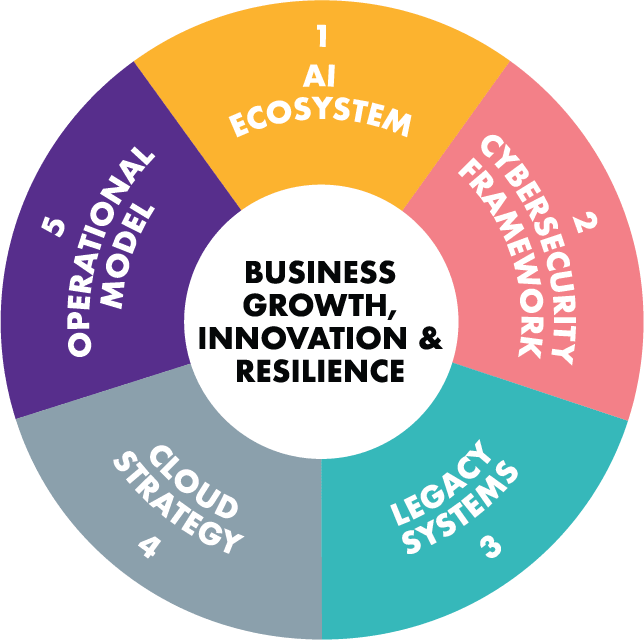
The most important point is that these decisions are not separate: AI depends on data quality, identity, permissions, cybersecurity, and modern systems; cyber maturity affects what can safely move to the cloud; legacy systems determine how much complexity the business carries forward; and the operational model determines whether any of it can be sustained.
The five decisions below give executives a practical way to pressure-test their technology strategy for 2027. Each one affects how well the organization can manage risk, modernize operations, and create room for growth without adding unnecessary complexity.
The 5 technology decisions that drive growth in 2027
Stronger together: These five decisions are interconnected. When aligned, they create a resilient technology foundation that reduces risk, improves efficiency, and accelerates growth.
1. Build an Intentional AI Ecosystem
AI is already in your organization. Employees are using it to write emails, analyze data, and speed up daily tasks, often without formal approval. The risk isn’t adoption; it’s unmanaged adoption.
Heading into 2027, the executive question will move beyond which AI tools employees can use and toward what AI agents should be allowed to see, access, decide, and do across business systems.
What AI Decisions Should Mid‑Market Executives Make in 2027?
- Define the approved AI toolset and eliminate shadow AI.
- Set integration standards so AI connects cleanly to systems and data flows.
- Establish guardrails for data protection, permissions, and compliance.
- Measure productivity impact so AI improves operations rather than fragments them.
Leapfrog CTO, Emmett “Trey” Hawkins III, sees firsthand how AI adoption breaks down inside mid‑market environments: “AI is powerful, but it also depends on clean data, clear permissions, strong security, and good governance. If a company’s IT environment is already fragmented and poorly managed, AI can amplify the confusion.”
The challenge for mid-market organizations is unique: leaders need enterprise‑grade governance without enterprise‑level bureaucracy. That means establishing clear usage standards, defining approved tools, and ensuring every AI capability aligns with security and data‑handling requirements.
That makes data readiness a practical leadership issue, not just a technical one: leaders need to know which data is trusted, who owns it, who can access it, and whether it is governed well enough to support AI responsibly.
Why this decision matters: AI can accelerate growth, but only if it’s deployed intentionally. A cohesive AI ecosystem reduces risk, improves efficiency, and ensures innovation doesn’t outpace governance.
2. Choose a Cybersecurity Framework That Scales With Your Business
Cybersecurity expectations have changed dramatically. Insurers, auditors, and boards now expect measurable maturity, not ad‑hoc controls or “best effort” security. The conversations around cyber risk and governance are justified:
The framework matters, but it is not the decision by itself. The larger executive decision is whether the organization can measure cyber risk, assign ownership, operate controls consistently, and demonstrate maturity to customers, insurers, auditors, and the board.
1 in 4 middle-market organizations experienced a ransomware attack or demand in the past year, according to RSM’s Cybersecurity Special Report.
How Should Mid‑Market Leaders Choose a Cybersecurity Framework?
- Select a framework that fits your current business requirements and provides a clear path forward.
- Build a roadmap that moves the organization from reactive to predictable.
- Work with a partner who can operationalize controls, not just document them.
- Align security with business outcomes, not just compliance requirements.
The mid‑market sits in a difficult middle ground: too complex for small‑business solutions, but not resourced like the enterprise. A scalable framework provides clarity, accountability, and a structured path toward maturity.
Bryant G. Tow, Leapfrog CSO and Thought Leader on Forbes Technology Council, has spent decades helping organizations mature their security posture, and his guidance is consistent. “Governance is your first line of defense. Policies, training, and hygiene matter more than any single tool.”
Why this decision matters: A strong cybersecurity framework reduces operational risk, satisfies insurers, and gives leadership confidence that the organization can support modern technology initiatives without exposing itself.
3. Address Legacy Systems Before They Become Strategic Blockers
Legacy systems are more than technical debt; they’re operational drag. They slow down modernization, limit AI adoption, and create security gaps that become harder to close each year.
Legacy environments also make data harder to trust. When critical information is scattered across aging systems, disconnected applications, and unclear ownership models, AI, reporting, compliance, and customer experience all become harder to improve.
What’s the Best Way to Modernize Legacy Systems in 2027?
Executives must determine:
- Which systems can be modernized
- Which should be retired
- Which require full replacement
- How to sequence modernization without disrupting operations
This decision requires honesty. Some systems can be upgraded; others are holding the business back. The organizations that win will be the ones that stop “making do” and start designing for the future.
Why this decision matters: Legacy systems quietly shape everything: speed, security, customer experience, and innovation. Addressing them proactively is one of the most strategic moves a mid‑market leader can make.
4. Set a Cloud Modernization Strategy That Actually Works
Most organizations are already in the cloud, but few are using it well. Costs creep, architecture becomes inconsistent, and security controls lag behind.
By 2027, the question is less whether the organization is “in the cloud” and more whether each workload is in the right place: SaaS, public cloud, private cloud, hybrid infrastructure, or on premises.
How Can Mid‑Market Organizations Modernize the Cloud Effectively?
Executives must clarify:
- How to optimize cloud spend without sacrificing performance
- How to modernize applications in a way that reduces complexity
- How to ensure governance and security keep pace with adoption
- How to build a cloud environment that supports AI, automation, and future growth
Cloud modernization is no longer a lift‑and‑shift project. It’s a multi‑year strategy that touches architecture, operations, security, and vendor management.
Cloud is not automatically cheaper, simpler, or more resilient, so leaders need a workload placement strategy based on cost, risk, performance, resilience, data sensitivity, and operational complexity.
Why this decision matters: A modern cloud environment unlocks scalability, resilience, and predictable costs, all essential for organizations navigating rapid change.
5. Choose the Right Operational Model: Internal, Co‑Managed, or Fully Managed
The mid‑market is under pressure: rising complexity, talent shortages, and increasing governance requirements. The operational model you choose determines how well your organization can keep up.
How Do You Know If Your Operational Model Can Scale?
- Assess whether internal IT has the bandwidth and expertise to support growth.
- Evaluate co‑managed options for the right balance of control and support.
- Consider fully managed operations for stability, predictability, and reduced burnout.
- Understand how each model impacts security, modernization, and long‑term strategy.
This is one of the most consequential decisions leaders make. The right model reduces burnout, improves security, and ensures the organization can support AI, cloud, and modernization initiatives without constant firefighting.
“A good MSP helps you operate IT in a way that supports the business, protects the company, and reduces unnecessary friction.” — Emmett “Trey” Hawkins III, CTO, Leapfrog Services
Why this decision matters: Your operational model determines your ability to perform. The wrong model creates bottlenecks; the right one creates momentum.
Conclusion: A Year for Interdependent IT Discussions and Decisions
These decisions don’t stand alone. AI depends on clean data and modern systems. Cyber maturity determines whether cloud adoption is safe. Legacy systems shape how quickly modernization can happen. And your operational model determines whether any of it is sustainable.
For many teams, these issues are already showing up in budget conversations, audit requirements, AI usage, and daily IT capacity. When leaders make these decisions together and not in isolation, the organization moves more smoothly with clear, intentional technology decisions. The kind that strengthens security, streamlines operations, and creates space for innovation.
Leapfrog has watched technology cycles come and go since the 90’s, and one lesson is clear: every new wave promises simplification, but too often it gets layered on top of the complexity left behind by the last one. AI will be no different unless leaders address the foundation first.
If your team is evaluating AI tools, wrestling with legacy systems, preparing for a cybersecurity audit, or trying to modernize the cloud without disrupting the business, you don’t have to navigate it alone. Leapfrog has spent more than 25 years helping executives make these exact decisions with our proven methodology.
“We’re not about technology for technology’s sake. Our goal is to unlock business value through technology, focusing on meaningful outcomes.” — Karl Kleinert, COO, Leapfrog Services
If you’re ready to move from IT uncertainty to momentum, reach out to Leapfrog today. A conversation now can clarify priorities, reduce risk, and set your organization up for a stronger, more resilient future.
FAQ: Technology Decisions for Mid‑Market Executives in 2027
What technology decisions matter most for mid‑market companies in 2027? AI governance, cybersecurity frameworks, legacy modernization, cloud strategy, and operational models are the five decisions that most directly impact competitiveness and resilience.
How can executives reduce risk when adopting AI tools? By defining approved tools, establishing governance standards, aligning AI with security requirements, and eliminating shadow AI across the organization.
What’s the fastest way to improve cybersecurity maturity? Adopt a scalable framework, build a roadmap, and partner with a team that can operationalize controls rather than simply document them.
How do I know if my operational model is holding the business back? Look for signs like burnout, project delays, rising security gaps, and an inability to support modernization initiatives.